Mystery Surrounds Glowing Shockwave From Dead Star: RXJ0528+2838 Defies Explanation
Astronomers are baffled by a glowing shockwave surrounding the white dwarf star RXJ0528+2838. Learn why this discovery challenges current astrophysics theories and what the future of research holds.
Mystery Surrounds Glowing Shockwave From Dead Star: RXJ0528+2838 Defies Explanation
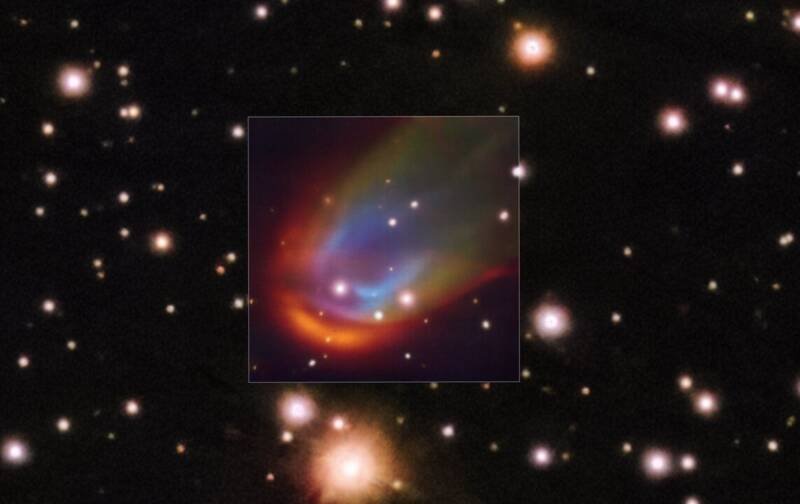
Astronomers have discovered something truly perplexing in the cosmos: a glowing shockwave surrounding a white dwarf star called RXJ0528+2838. This shockwave isn't behaving as predicted by current scientific understanding, leaving researchers scratching their heads and rethinking existing theories about stellar evolution.
What is RXJ0528+2838?
RXJ0528+2838 is a white dwarf, the dense remnant of a star like our Sun after it has exhausted its nuclear fuel. Think of it as the stellar equivalent of ashes left after a fire. These white dwarfs are incredibly hot and slowly cool down over billions of years. But RXJ0528+2838 is exhibiting unusual behavior.
The Unexpected Shockwave
The shockwave surrounding RXJ0528+2838 is emitting intense radiation, visible to telescopes like NASA's Chandra X-ray Observatory. Shockwaves are created when something moves through a medium faster than the speed of sound. In this case, the shockwave suggests a powerful outflow of material from the white dwarf. The problem? Current models can't fully explain the source or intensity of this outflow.
Why This News Matters
This discovery is more than just a cool space picture. It highlights the gaps in our knowledge about how stars evolve and die. If we can't explain the processes happening around white dwarfs, we might be missing crucial pieces of the puzzle when it comes to understanding the universe's overall evolution.
Furthermore, white dwarfs play a key role in many cosmic events, like Type Ia supernovae, which are used to measure the expansion of the universe. A better understanding of their behavior could refine these measurements and give us a more accurate picture of the cosmos.
Our Analysis
In our opinion, the most significant aspect of this discovery is the challenge it poses to existing theories. The fact that the outflow and resulting shockwave are so unexpected suggests that we might be overlooking a crucial physical process. Perhaps there are internal dynamics within the white dwarf that we don't fully understand, or maybe the interaction with the surrounding interstellar medium is more complex than previously assumed.
This could impact how we think about other white dwarfs and their role in the universe. If RXJ0528+2838 is not an isolated case, there could be a whole population of white dwarfs exhibiting similar, yet undetected, phenomena.
Future Outlook
The discovery of this unexplained shockwave opens up exciting avenues for future research. Here are some potential directions:
- More Detailed Observations: Using telescopes with higher resolution and sensitivity to observe RXJ0528+2838 in different wavelengths of light could reveal more about the shockwave's composition and structure.
- Advanced Modeling: Scientists need to develop more sophisticated computer models that incorporate a wider range of physical processes to simulate the behavior of white dwarfs and their surrounding environments.
- Searching for Similar Systems: Actively searching for other white dwarfs exhibiting similar unexplained shockwaves could help determine whether RXJ0528+2838 is a unique case or part of a larger phenomenon.
Ultimately, solving the mystery of the RXJ0528+2838 shockwave will require a collaborative effort between observational astronomers and theoretical astrophysicists. It's a reminder that even in a field as well-studied as stellar evolution, there are still plenty of surprises waiting to be uncovered. It is an exciting time for space exploration.
The ongoing research into this glowing shockwave is pushing the boundaries of what we know about stellar remnants and could lead to significant advancements in our understanding of the universe. It is another exciting discovery showing how much more is out there to learn.