GPU as a Service Market to Explode: Understanding the $19 Billion Opportunity
The GPU as a Service (GPUaaS) market is projected to reach $19.34 billion by 2030, growing at a 27.2% CAGR. Learn why this market is booming and what it means for businesses.
Graphics Processing Unit (GPU) as a Service Market Poised for Explosive Growth
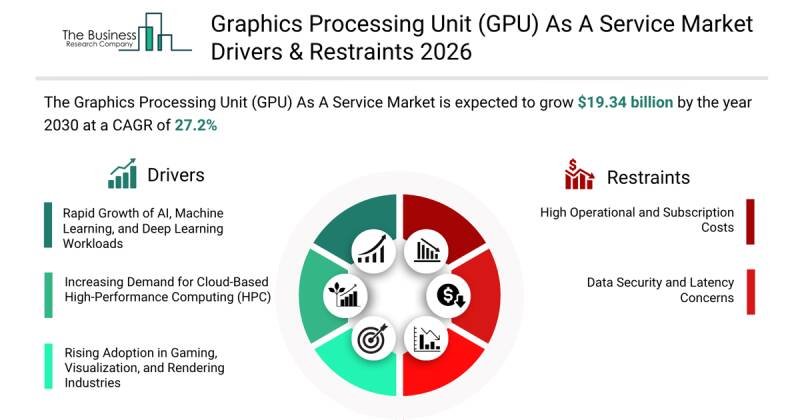
The Graphics Processing Unit (GPU) as a Service (GPUaaS) market is on a tear! According to a recent report by The Business Research Company, the market is projected to reach a staggering $19.34 billion by 2030. This represents a compound annual growth rate (CAGR) of 27.2%, highlighting the immense potential of this rapidly evolving sector.
But what exactly is GPUaaS, and why is it experiencing such phenomenal growth?
Understanding GPU as a Service (GPUaaS)
Traditional GPUs are physical hardware components that handle the intense processing power needed for graphics rendering, video editing, scientific simulations, and, increasingly, artificial intelligence (AI) workloads. Setting up and maintaining your own GPU infrastructure can be incredibly expensive and complex. GPUaaS offers a solution by providing access to virtualized GPUs hosted in the cloud. Businesses can rent these GPUs on demand, paying only for what they use.
Think of it like renting a powerful computer instead of buying one. This offers flexibility, scalability, and cost savings, particularly for organizations with fluctuating GPU needs or limited IT resources.
Why This News Matters
This projected growth signifies a significant shift in how businesses approach computationally intensive tasks. The widespread adoption of GPUaaS indicates:
- Democratization of AI: GPUaaS makes powerful computing resources accessible to smaller businesses and startups that couldn't previously afford to build their own infrastructure. This levels the playing field and fosters innovation.
- Increased Efficiency: By outsourcing GPU needs to cloud providers, companies can focus on their core competencies instead of managing complex hardware.
- Faster Time to Market: Rapid provisioning of GPU resources allows businesses to accelerate development cycles for AI models, simulations, and other demanding applications.
- Cost Optimization: Pay-as-you-go pricing models offer significant cost advantages compared to upfront investments in hardware and ongoing maintenance.
Our Analysis
The surge in the GPUaaS market is driven by several key factors. The most prominent is the explosion of AI and machine learning applications. These technologies rely heavily on GPUs to train complex models. As more industries adopt AI, the demand for GPU resources will only continue to rise. In our opinion, the growth projections are realistic, and may even be conservative if AI adoption accelerates further.
Cloud providers like Amazon Web Services (AWS), Microsoft Azure, and Google Cloud Platform are heavily invested in GPUaaS, offering a wide range of GPU instances optimized for different workloads. NVIDIA, a dominant player in the GPU market, also plays a crucial role by providing the underlying GPU technology that powers these cloud services.
Furthermore, the increasing complexity of scientific simulations and the growing popularity of cloud gaming contribute to the demand for GPUaaS. Industries like healthcare, finance, and manufacturing are leveraging GPU-powered simulations for research, analysis, and product development.
Key Drivers of Growth:
- Rising adoption of Artificial Intelligence (AI) and Machine Learning (ML).
- Increasing demand for high-performance computing in various industries.
- Cost-effectiveness and scalability of cloud-based solutions.
- Advancements in virtualization and GPU technology.
Future Outlook
The future of the GPUaaS market looks incredibly bright. We anticipate further innovation in GPU technology, leading to more powerful and efficient cloud-based solutions. The increasing adoption of edge computing will also drive demand for GPUaaS, as businesses seek to process data closer to the source. This could impact cloud providers heavily as each tries to take as much market share as possible.
We also expect to see more specialized GPUaaS offerings tailored to specific industries and applications. For instance, cloud providers may offer dedicated GPU instances optimized for video editing, gaming, or scientific research.
Ultimately, the GPUaaS market is poised to revolutionize how businesses access and utilize high-performance computing resources. It will empower organizations of all sizes to innovate and compete in the age of AI.