Navy STEM Program Inspires Galveston Students: A Look at the Future of Military Careers
The U.S. Navy is bringing STEM to Galveston high schools! Learn how this program inspires students and what it means for the future of military technology.



The U.S. Navy is bringing STEM to Galveston high schools! Learn how this program inspires students and what it means for the future of military technology.
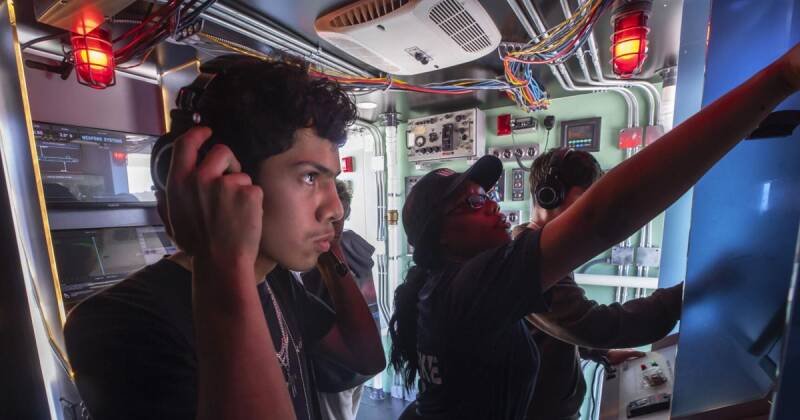
The U.S. Navy recently brought an exciting mobile STEM (Science, Technology, Engineering, and Mathematics) experience to Ball High School in Galveston, Texas. This initiative aims to introduce students to the vast array of technical career opportunities available within the military. By offering immersive, team-based simulations, the Navy hopes to ignite a passion for STEM fields and encourage students to consider a future in service.
Instead of relying solely on lectures and textbooks, the Navy's program employs engaging simulations that allow students to actively participate and learn by doing. These simulations are designed to mimic real-world challenges faced by Navy personnel, requiring students to collaborate, problem-solve, and apply their STEM knowledge in a practical setting. This hands-on approach is significantly more effective than traditional teaching methods at capturing students' attention and fostering a deeper understanding of the material.
The program's goal is to demonstrate the relevance of STEM education to real-world careers. By showcasing how these disciplines are applied in the Navy, the program hopes to inspire students to pursue further education and training in STEM fields. This, in turn, could lead to a new generation of skilled professionals who are equipped to tackle the technological challenges of the 21st century.
This Navy initiative highlights the growing importance of STEM education in preparing students for future careers. The military, in particular, relies heavily on technological advancements and requires a workforce with strong STEM skills to maintain its competitive edge. By investing in STEM outreach programs, the Navy is not only helping to develop the next generation of military personnel but also contributing to the overall strength of the U.S. workforce.
Furthermore, such programs address a critical need to diversify the STEM pipeline. By engaging students from diverse backgrounds, the Navy can help to create a more inclusive and representative workforce, bringing fresh perspectives and innovative ideas to the table.
In our opinion, this program represents a smart and strategic investment by the Navy. By engaging with students at a young age, they are planting the seeds for future recruitment and fostering a positive perception of military service. The use of immersive simulations is particularly effective, as it allows students to experience the excitement and challenge of STEM careers firsthand.
This type of outreach could have a ripple effect. Students exposed to these programs might share their experiences with family and friends, further expanding awareness of STEM opportunities. This increased awareness could, in turn, lead to greater enrollment in STEM courses and a more robust pipeline of qualified professionals.
We anticipate that the Navy will continue to expand its STEM outreach efforts in the coming years. As technology continues to evolve, the need for skilled STEM professionals will only increase. Programs like the one at Ball High School are essential for ensuring that the U.S. military has access to the talent it needs to remain at the forefront of innovation.
This could impact local economies too. By inspiring more students to pursue STEM careers, the program could contribute to the growth of the tech industry in Galveston and surrounding areas. A skilled workforce attracts businesses and investment, leading to job creation and economic prosperity.
Moving forward, it will be crucial to track the long-term impact of these programs. Are students who participate in these initiatives more likely to pursue STEM degrees? Are they more likely to consider a career in the military? Answering these questions will help the Navy refine its outreach efforts and ensure that they are as effective as possible. It is also important to encourage other organizations to implement similar programs, thus expanding the reach and impact of STEM education.