Modi and Rahul Gandhi's Brief Meeting: What Does it Mean?
Explore the brief exchange between PM Modi and Rahul Gandhi in Parliament. What could this seemingly small gesture signal amidst their political rivalry?
Modi and Rahul Gandhi Exchange Greetings: A Moment of Political Intrigue
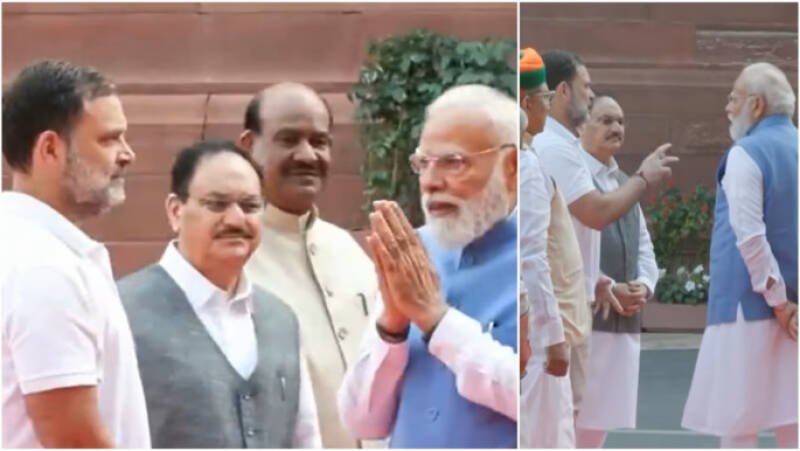
It's not every day that political rivals share a friendly moment, especially in the often-charged atmosphere of Parliament. Recently, Prime Minister Narendra Modi and Rahul Gandhi engaged in a brief exchange, drawing attention and sparking speculation about its significance.
What Happened?
Reports indicate that Modi and Gandhi greeted each other and had a short conversation within the parliamentary premises. While the exact content of their discussion remains undisclosed, the mere occurrence of such an interaction is noteworthy, given their well-documented political rivalry.
Why This News Matters
In a political landscape often defined by sharp divisions and heated debates, even a small gesture like this can carry weight. It raises questions about the potential for cross-party dialogue and the possibility of finding common ground on issues facing the nation.
* **Symbolic Importance:** The exchange can be interpreted as a signal, however subtle, of a willingness to engage in civil discourse despite ideological differences.
* **Impact on Political Climate:** It could potentially ease tensions and foster a more collaborative environment in Parliament.
* **Public Perception:** Such interactions can influence public perception of political leaders and potentially reduce the level of polarization in the political discourse.
Our Analysis
The relationship between Modi and Gandhi has been characterized by strong disagreements and frequent criticisms leveled by both sides, both inside and outside the Parliament. Therefore, this seemingly simple exchange is significant because it deviates from the norm. In our opinion, this isn't necessarily a sign of a dramatic shift in political alliances, but it could be a calculated move to project an image of statesmanship and openness to dialogue.
It’s important to remember that political interactions are often carefully orchestrated. This could be a strategic move to:
* **Soften Modi's image:** By appearing cordial, Modi may aim to project an image of being above petty political squabbles.
* **Signal openness:** This could signal that despite political differences, there is a willingness to engage in discussion on critical national issues.
* **Preempt criticism:** Showing courtesy could potentially defuse criticism of being unwilling to communicate with the opposition.
Future Outlook
It's difficult to predict whether this interaction will lead to any substantial changes in the political landscape. However, it's worthwhile to consider a few possibilities.
Possible Scenarios:
* **Continued Detente:** This exchange could be a one-off event, with political relations returning to their usual adversarial state.
* **Increased Dialogue:** This interaction might open the door to further communication and even collaboration on specific issues of national importance.
* **No Tangible Impact:** The exchange may be largely symbolic, with minimal impact on the overall political dynamics.
It is important to note that these are just potential scenarios, and the actual outcome will depend on a variety of factors, including the political climate, upcoming elections, and the specific issues at stake. In our opinion, the key takeaway here is that seemingly small interactions can offer glimpses into the evolving dynamics of Indian politics. This could impact how the public views both leaders and their parties, and it will be interesting to see if more such positive interactions take place in the future.
It remains to be seen whether this brief encounter marks a turning point in their relationship or simply a fleeting moment of civility amidst the political turbulence. Only time will tell.