Indore Mediation Centre Achieves 96% Dispute Resolution Success
Indore's Siddhi Mediation Centre resolves 96% of disputes in 1,000 days. Learn how this community-based approach works and why it matters for accessible justice.



Indore's Siddhi Mediation Centre resolves 96% of disputes in 1,000 days. Learn how this community-based approach works and why it matters for accessible justice.
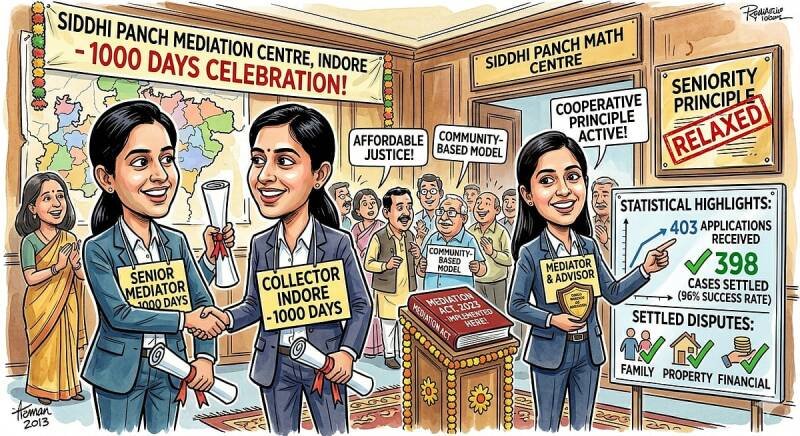
A remarkable story is unfolding in Indore, India, where the Siddhi Panch Mediation and Legal Advisory Centre has successfully completed 1,000 days of operation. This center has become a beacon of hope for resolving disputes quickly and amicably, boasting an impressive 96% success rate.
Over the past 1,000 days, the center received 403 applications. Of those, a staggering 398 cases were settled through mutual agreement. These cases covered a range of common but often emotionally charged issues, including family disagreements, property disputes, and financial conflicts. The success of the Siddhi Panch Mediation Centre highlights the growing importance of alternative dispute resolution (ADR) mechanisms in easing the burden on traditional court systems.
Mediation is a process where a neutral third party (the mediator) helps disputing parties communicate and negotiate to reach a mutually acceptable agreement. Unlike a judge, the mediator doesn't make a decision but facilitates the conversation and helps parties find common ground.
This approach is often faster, cheaper, and less stressful than going to court. It also empowers individuals to control the outcome of their disputes, leading to more satisfying and sustainable solutions.
The success of the Siddhi Panch Mediation Centre is significant for several reasons:
In our opinion, the Siddhi Panch Mediation Centre's success is a testament to the power of community-driven initiatives and the effectiveness of mediation as a dispute resolution tool. The high success rate speaks volumes about the willingness of people to find common ground when given a structured and supportive environment to do so.
The fact that the center has successfully resolved a significant number of cases relating to family, property, and financial disputes suggests that mediation can be effective across a diverse range of issues. This is particularly important in a society like India, where such disputes are often a major source of social tension and conflict.
This model could be successfully replicated in other cities and communities across India. By investing in mediation centers and training mediators, governments and NGOs can create a more just and equitable society.
The future looks bright for mediation in India, particularly with the recent passage of the Mediation Act, 2023. This legislation provides a legal framework for mediation and encourages its use in a wide range of contexts.
The success of centers like the Siddhi Panch Mediation Centre will likely inspire other communities to adopt similar approaches. This could lead to a significant increase in the use of mediation across the country, which could have a transformative impact on the justice system.
This could impact future policy decisions surrounding alternative dispute resolution funding, training, and infrastructure, making it easier for everyday citizens to access a fair resolution to disagreements.
Furthermore, as awareness of mediation grows, it is likely that more people will choose mediation as their first course of action when faced with a dispute. This could lead to a more peaceful and harmonious society, where conflicts are resolved through dialogue and compromise rather than litigation and confrontation.